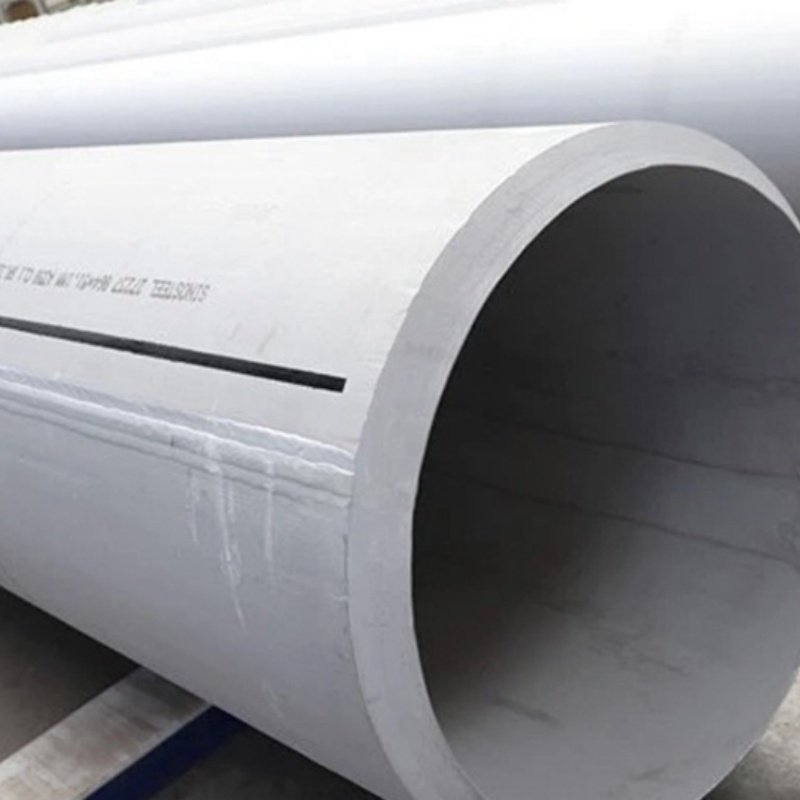


Inconel 600 seamless pipe (UNS N06600) is a nickel-chromium-iron alloy pipe and tube produced to ASME SB-167. Its 14.0–17.0% chromium content gives it outstanding resistance to oxidising media and dry heat, while the high nickel base provides exceptional resistance to caustic solutions and reducing acids. It is one of the most widely specified alloys in heat treatment, chemical processing and furnace hardware.
Specification and Designation
| Designation | Value |
|---|---|
| UNS number | N06600 |
| ASME specification | SB-167 |
| ASTM equivalent | B163 (tube) |
| Product forms | Seamless pipe and tube, cold-worked annealed / hot-worked annealed / hot-finished |
| Material class | Nickel-chromium-iron alloy |
Chemical Composition (ASME SB-167, Table 1)
| Element | Composition, % | Element | Composition, % |
|---|---|---|---|
| Nickel | Remainder | Carbon | 0.15 max |
| Chromium | 14.0–17.0 | Manganese | 1.0 max |
| Iron | 6.0–10.0 | Silicon | 0.5 max |
| Copper | 0.5 max | Sulfur | 0.015 max |
Composition limits quoted directly from ASME BPVC Section II Part B, SB-167 Table 1. Other elements (niobium, titanium, aluminium, yttrium) are not specified for N06600 in this specification.
Supply Range
| Parameter | Range |
|---|---|
| Outer diameter | 6 mm – 610 mm (1/4″ – 24″) |
| Wall thickness | 0.5 mm – 60 mm, subject to standard availability |
| Length | Random length, or cut to customer requirement |
| Delivery condition | Cold drawn, solution annealed, pickled |
| Surface condition | Bright annealed, pickled, polished |
| End finish | Plain end, bevelled end |
Why Inconel 600 Is Selected
Oxidising environments. The chromium content forms a protective Cr₂O₃ scale that resists further oxidation at elevated temperature. This is why 600 appears so often in furnace internals, radiant tubes, heat treatment baskets and heat exchanger components handling air and combustion gases.
Caustic and reducing media. The high nickel base carries resistance to caustic soda, caustic potash and many mineral acids, including sulphuric, phosphoric and hydrochloric under reducing conditions. This dual capability — oxidising at temperature, reducing in wet chemistry — is unusual and is the core reason the alloy is specified across such a wide range of industries.
Sulphur and carbonisation environments. 600 resists sulphidation and carburisation far better than austenitic stainless steels, which is why it appears in petrochemical furnace and reformer service alongside higher-nickel alloys.
Limitations worth noting. Inconel 600 is not a molybdenum-bearing alloy. In strongly reducing acidic conditions, or in chloride-bearing service where pitting matters, a molybdenum-alloyed grade such as Inconel 625 or Hastelloy C-276 is the better choice. 600 also has limited resistance to wet chlorine and to molten salt corrosion.
Heat Treatment
SB-167 covers material in cold-worked annealed, hot-worked annealed and hot-finished conditions. For maximum corrosion resistance, material should be supplied in the annealed condition. Verify the specific heat treatment recorded on the mill test certificate at the time of purchase — the condition affects both corrosion performance and dimensional tolerances.
Inspection and Certification
- EN 10204 3.1 or 3.2 mill test certificate with heat number, measured chemistry and mechanical test results
- Hydrostatic or non-destructive electric test, per the purchase order
- Eddy current testing and ultrasonic testing available for full-length coverage
- Positive material identification (PMI) with X-ray fluorescence, available on request
- Hardness test and, where required, grain size verification per ASTM E112
- Flattening and flaring tests per the applicable specification
Packing and Delivery
Pipe is supplied with plastic end caps, then bundled or individually wrapped, with rust-preventive oil or VCI paper applied to the surface, packed in woven bags, wooden cases or steel frames suitable for long-distance sea transport. Export packing complies with standard container loading practice.
Applications
Typical service includes heat treatment furnace components, chemical processing equipment, caustic and acid handling, nuclear steam generator internals, food and pharmaceutical processing, aerospace and superalloy production, and petrochemical reformer and hydrotreater piping.
Related Products
For the same product family in other forms, see our nickel alloy flanges, nickel alloy pipe fittings and nickel alloy bars. For comparison on grade selection between alloys, our nickel alloy seamless pipe page covers the full grade matrix.
Frequently Asked Questions
What is the difference between Inconel 600 and Inconel 601?
Alloy 601 (UNS N06601, also SB-167) adds 1.0–1.7% aluminium and up to 0.25% titanium to the 600 composition. The aluminium improves resistance to high-temperature oxidation and carburisation, particularly in cyclic service and in reducing atmospheres where chromium alone is not enough. For furnace hardware exposed to carburising gas, 601 is usually the better choice; for general chemical and heat treatment service, 600 remains the standard.
Can Inconel 600 be used in seawater?
Not as a primary choice. Alloy 600 has no molybdenum, so its pitting resistance equivalent number is low compared with 6Mo or super duplex grades. It will resist general seawater corrosion reasonably, but crevice and pitting attack in stagnant or shielded seawater service is a real risk. For seawater systems, specify a molybdenum-bearing alloy or super duplex instead.
What material specification should be stated on a purchase order?
State the following explicitly: grade (UNS N06600), governing specification (ASME SB-167), product form (seamless pipe or seamless tube), OD and wall thickness or NPS and schedule, delivery condition, length, and the certificate type required (EN 10204 3.1 or 3.2). Also state any supplementary requirements such as eddy current testing, PMI or additional heat treatment.
Is Inconel 600 weldable without preheat?
Yes. The alloy has good weldability and no preheat is normally required. Filler metal should match the base grade, typically Alloy 600 filler, with inert gas shielding (typically argon with a small hydrogen addition). Post-weld heat treatment is not generally required, though solution annealing may be specified where the service involves severe oxidation and the weld has been contaminated by machining oils or embedded iron.
How is Inconel 600 distinguished from Inconel 625?
Alloy 625 contains niobium and molybdenum (2.5–3.5% Mo, 3.6–4.4% Nb) and derives its strength from solid solution plus precipitation hardening. Alloy 600 has no molybdenum and no niobium. If your service involves wet chlorine, sour gas, or strong reducing acids, 625 or C-276 is the appropriate selection.
Request a Quotation
Send us the grade, dimensions, quantity and any inspection requirement you need. Our engineers respond within one working day with availability, technical confirmation and a quotation. Contact us by WhatsApp at +86 186 2137 7760 or by email at info@nickelalloyfitting.com.