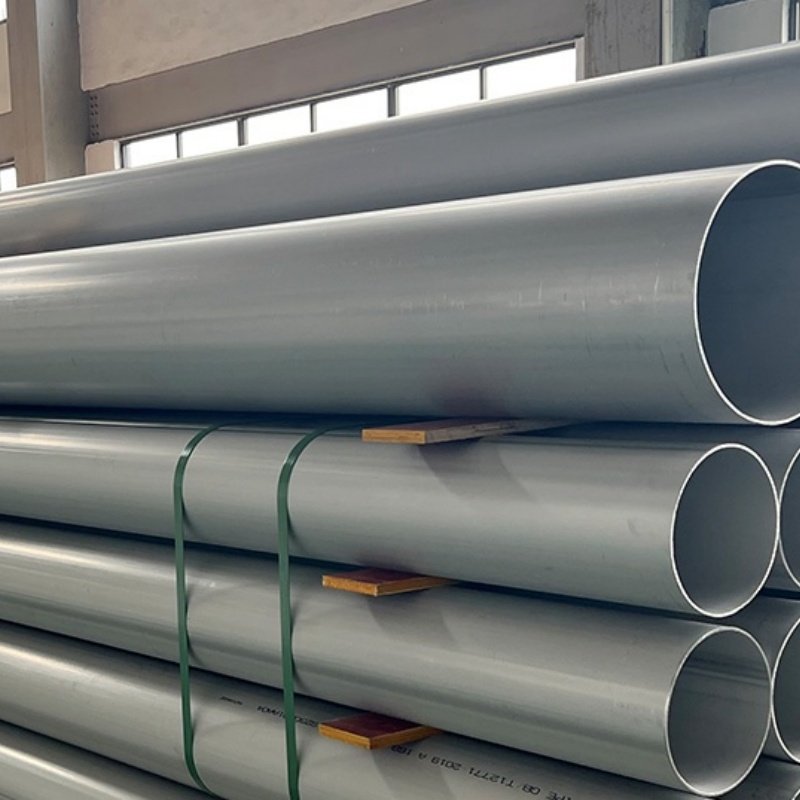


Incoloy 800 and 800H are austenitic nickel-iron-chromium alloys supplied as
seamless pipe and tube to ASME SB-407. The two grades share a base chemistry but they
are not chemically identical: 800H carries a tighter nickel and chromium window, a controlled
carbon range, and substantially more titanium. That difference is what makes 800H the creep-rupture
grade and 800 the general-corrosion grade.
Dual Standard Designation
| Designation | Specification | Product form |
|---|---|---|
| UNS N08800 | — | Alloy 800 identification |
| UNS N08801 | — | Alloy 800H identification |
| ASME SB-407 | ASTM B407 | Seamless pipe and tube |
| ASME SB-163 | ASTM B163 | Seamless condenser & heat-exchanger tubes |
| ASME SB-408 | ASTM B408 | Rod and bar (reference form) |
SB-407 Scope 1.1 covers UNS N08120, N08800, N08801, N08810, N08811, N08890 and
N06811 in the form of cold-worked and hot-finished annealed seamless pipe and tube. The same clause
states that N08800 and N06811 are normally employed up to and including 1100 °F (593 °C),
whereas N08120, N08810, N08811 and N08890 are normally employed above 1100 °F where
resistance to creep and rupture is required, and are annealed to develop a controlled grain size.
Chemical Composition (ASME SB-407, Table 1)
| Element | UNS N08800, % | UNS N08801 (800H), % |
|---|---|---|
| Nickel | 30.0 min – 35.0 max | 30.0 min – 34.0 max |
| Chromium | 19.0 min – 23.0 max | 19.0 min – 22.0 max |
| Iron | 39.5 min A | 39.5 min A |
| Manganese, max | 1.5 | 1.5 |
| Carbon | 0.10 max B | 0.06 min – 0.10 max |
| Copper, max | 0.75 | 0.5 |
| Silicon, max | 1.0 | 1.0 |
| Sulfur, max | 0.015 | 0.015 |
| Aluminum | 0.15 min – 0.60 max | not specified by SB-407 Table 1 |
| Titanium | 0.15 min – 0.60 max | 0.75 min – 1.50 max |
A Iron shall be determined arithmetically by difference.
B SB-407 Table 1 note B: Alloy UNS N08800, 0.10 max; UNS N08810, 0.05–0.10;
UNS N08811, 0.06–0.10. Product (check) analysis variations per Specification B 829.
Mechanical Properties (ASME SB-407, Table 2)
| Alloy | Condition (Temper) | Tensile min, psi (MPa) | Yield 0.2% offset min, psi (MPa) | Elongation in 2 in./50 mm, min % |
|---|---|---|---|---|
| UNS N08800 | cold-worked annealed | 75 000 (520) | 30 000 (205) | 30 |
| UNS N08800 | hot-finished annealed or hot-finished | 65 000 (450) | 25 000 (170) | 30 |
| UNS N08801 | hot-finished annealed or cold-worked annealed | 65 000 (450) | 25 000 (170) | 30 |
Hardness is not mandated by SB-407 for N08800 or N08801, so no hardness value is stated here rather
than substituting a reference figure.
Size Range
Dimensions per ASME B36.19M; outside-diameter and wall-thickness permissible variations per
SB-407 Table 3. Indicative commercial coverage is OD 6.00 mm to 914.4 mm, wall 0.5 to 50 mm.
Send us your NPS and wall list for confirmation against mill capability.
| NPS | OD (in) | OD (mm) | Sch 5S (mm) | Sch 10S (mm) | Sch 40S (mm) | Sch 80S (mm) |
|---|---|---|---|---|---|---|
| 1/2 | 0.840 | 21.34 | 1.65 | 2.11 | 2.77 | 3.73 |
| 3/4 | 1.050 | 26.67 | 1.65 | 2.11 | 2.87 | 3.91 |
| 1 | 1.315 | 33.40 | 1.65 | 2.77 | 3.38 | 4.55 |
| 1 1/2 | 1.900 | 48.26 | 1.65 | 2.77 | 3.68 | 5.08 |
| 2 | 2.375 | 60.33 | 1.65 | 2.77 | 3.91 | 5.54 |
| 3 | 3.500 | 88.90 | 2.11 | 3.05 | 5.49 | 7.62 |
| 4 | 4.500 | 114.30 | 2.11 | 3.05 | 6.02 | 8.56 |
| 6 | 6.625 | 168.28 | 2.77 | 3.40 | 7.11 | 10.97 |
Manufacturing Route & Heat Treatment
Hot-finished or cold-drawn followed by cold-worked annealing, per the SB-407 Table 2 conditions.
Cold-worked annealed pipe is annealed in a protective atmosphere; hot-finished annealed is furnished
pickled or bright. For creep service the material must be annealed to develop a controlled grain size,
and the grain size becomes a purchasing option that has to be stated on the order.
Inspection & Certification
- Hydrostatic or nondestructive electric test per SB-407 7.3, at the manufacturer’s option unless
otherwise specified on the purchase order - Grain size test per SB-407 7.2 for N08120, N08810 and N08811 — average ASTM No. 5 or coarser
- Chemical analysis and tension test one per lot
- Flattening and transverse guided bend per lot
- PMI (positive material identification) available on request
- MTC to EN 10204 3.1 standard; 3.2 available when third-party inspection is specified
Packing & Delivery
Plastic end caps on all sizes; wooden crates or steel frames for bundled large sizes; VCI anti-rust
paper and oil wrapping for long-term storage. Plain ends by default, beveled ends available on request.
Applications
Ethylene cracker furnace tubing, catalytic reformer charge lines, hydroprocessing reactor heat
exchangers, nuclear auxiliary heat-transfer piping, waste-heat boiler tubes, nitric acid and
caprolactam equipment.
Technical Notes
1. The 800 / 800H distinction is not “more carbon” — it is a different
chemistry column. Reading SB-407 Table 1 carefully, 800H is specified on its own line, not as a
carbon variant of 800. N08801 carries nickel 30.0–34.0 and chromium 19.0–22.0, both
narrower at the top end than N08800’s 30.0–35.0 and 19.0–23.0. More importantly,
titanium is 0.75–1.50% for 800H against 0.15–0.60% for 800, and SB-407 Table 1 states no
aluminium requirement for N08801 at all. The high titanium is the real creep-rupture mechanism: Ti ties
up carbon as TiC and keeps chromium available for matrix corrosion resistance instead of being
consumed as Cr23C6 grain-boundary carbide. If you are buying 800H for furnace
service, verify the titanium on the MTC — a heat that meets 800 chemistry but not 800H chemistry
has less creep margin than the “800H” name implies.
2. Cold-worked annealed and hot-finished annealed 800 differ by about 15% in tensile
strength, and the mismatch is a real procurement error. SB-407 Table 2 gives N08800 two
separate rows: cold-worked annealed at 75 000 psi / 30 000 psi / 30%, and
hot-finished annealed or hot-finished at 65 000 psi / 25 000 psi / 30%. Note that
N08801 has only one row at 65 000 psi / 25 000 psi. So the two grades
even respond differently to delivery condition. When allowable stresses are taken from the ASME
Section II Part D tables, the condition on the purchase order must match the condition used
in the wall-thickness calculation, otherwise you can end up calculating for cold-drawn 800 and receiving
hot-finished 800H.
3. Welding 800H: keep interpass temperature under control or you lose the titanium
stabilisation you paid for. In 800H the protective effect comes from titanium tying carbon
into TiC rather than from aluminium, as it largely does in 800. Excess heat input lets titanium
react with nitrogen and oxygen and form brittle phases, and lets chromium carbide precipitate at the
grain boundary of the heat-affected zone. Field welding should hold interpass temperature down and
keep heat input stable; where the weld will see a corrosive service afterwards, a local solution
anneal of the weld and HAZ is worth evaluating to restore corrosion resistance. This differs from
carbon steel practice, where post-weld heat treatment is normally omitted, so it needs its own line
in the welding procedure specification.
Frequently Asked Questions
Is Incoloy 800H the same as Incoloy 800?
No. They share a base chemistry family but ASME SB-407 lists them as separate UNS entries with
separate rows. 800H (N08801) has a controlled carbon range of 0.06–0.10%, titanium
0.75–1.50% and no stated aluminium requirement, versus 800 (N08800) with carbon 0.10 max,
aluminium and titanium each 0.15–0.60%, and higher nickel and chromium ceilings. 800H is
selected for creep and rupture strength above 1100 °F (593 °C).
Which ASME specification governs Incoloy 800 seamless pipe?
ASME SB-407, identical to ASTM B407, Nickel-Iron-Chromium Alloy Seamless Pipe and Tube. SB-446 is
the rod and bar specification for a different alloy family and does not apply to this product form.
What is the difference between hot-finished annealed and cold-worked annealed?
For N08800, cold-worked annealed gives a higher tensile strength, 75 000 psi minimum, against
65 000 psi for hot-finished annealed; both meet 30% minimum elongation. N08801 is specified at
65 000 psi for either condition. The condition must be stated on the order because it changes
the allowable-stress basis for wall calculations.
Does SB-407 require a grain size for 800 or 800H?
Not for N08800 or N08801. The average ASTM No. 5 or coarser requirement in SB-407 7.2 applies to
N08120, N08810 and N08811. If your project specifies a grain size for 800H, state it on the order as an
additional requirement.
Can you supply EN 10204 3.2 certification?
Yes, when third-party inspection is specified on the purchase order. 3.1 is supplied as standard.
What size range can you supply?
Please send us your NPS and wall thickness list. Indicative commercial coverage is OD 6.00 mm to
914.4 mm with wall 0.5 to 50 mm, subject to mill confirmation for any individual line.