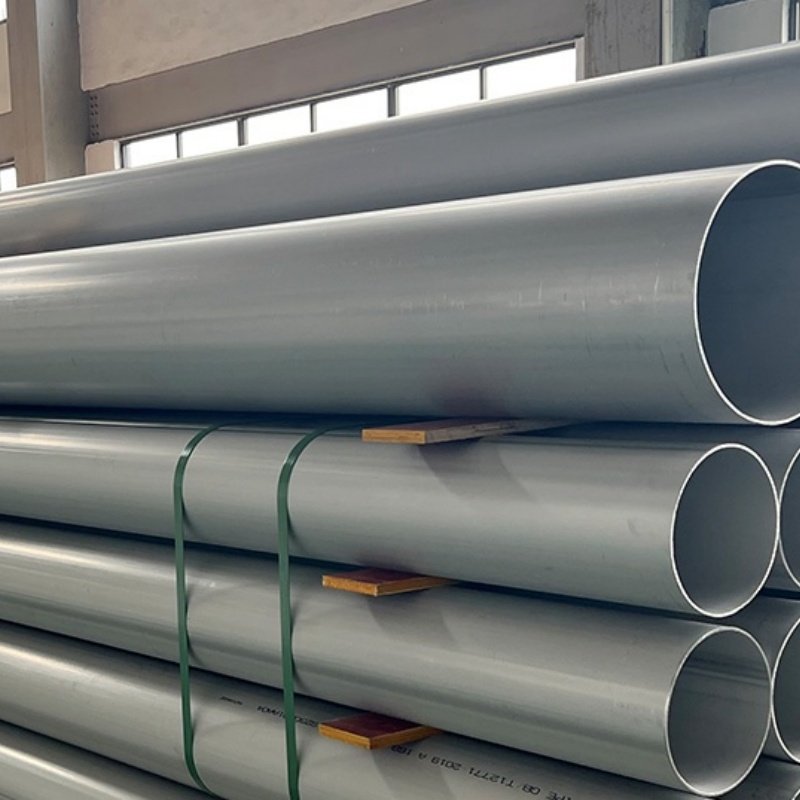


Incoloy 825 (UNS N08825) is a nickel-iron-chromium-molybdenum-copper alloy supplied
as seamless pipe and tube to ASME SB-423. It is a solid-solution alloy that combines
the general corrosion resistance of the 800 family with added molybdenum and copper, which is what
extends it into reducing acids and sour service.
Dual Standard Designation
| Designation | Specification | Product form |
|---|---|---|
| UNS N08825 | W.Nr. 2.4858 | Alloy identification |
| UNS N08221 | Alloy 825B | Molybdenum-rich variant |
| ASME SB-423 | ASTM B423 | Seamless pipe and tube |
| ASME SB-366 | ASTM B366 | Fittings |
SB-423 Scope 1.1 covers nickel-iron-chromium-molybdenum-copper alloys UNS N08825 and N08221 in
cold-worked and hot-finished seamless pipe and tube intended for general corrosive service, with the
general requirements for pipe and tube covered by Specification B 829.
Chemical Composition (ASME SB-423, Table 1)
| Element | UNS N08825, % | UNS N08221, % |
|---|---|---|
| Nickel | 38.0 – 46.0 | 39.0 – 46.0 |
| Chromium | 19.5 – 23.5 | 20.0 – 22.0 |
| Iron | 22.0 min | 22.0 min |
| Manganese, max | 1.0 | 1.0 |
| Carbon, max | 0.05 | 0.025 |
| Copper | 1.5 – 3.0 | 1.5 – 3.0 |
| Silicon, max | 0.5 | 0.5 |
| Sulfur, max | 0.03 | 0.03 |
| Aluminum, max | 0.2 | 0.2 |
| Titanium | 0.6 – 1.2 | 0.6 – 1.0 |
| Molybdenum | 2.5 – 3.5 | 5.0 – 6.5 |
Product (check) analysis variations per Specification B 829 (SB-423 5.2).
Mechanical Properties (ASME SB-423, Table 2)
| Alloy | Condition and size | Tensile min, ksi (MPa) | Yield 0.2% offset min, ksi (MPa) | Elongation in 2 in./50 mm, min % |
|---|---|---|---|---|
| UNS N08825 | hot-finished annealed | 75 (517) | 25 (172) | 30 |
| UNS N08825 | cold-worked annealed | 85 (586) | 35 (241) | 30 |
| UNS N08825 | hot-forming quality (hot-finished or cold-drawn annealed) | (A) | (A) | (A) |
| UNS N08221 | cold-finished, annealed | 79 (545) | 34 (234) | 30 |
(A) Values as prescribed in SB-423 Table X1.1 for small-diameter and light-wall (converter sizes).
Send us OD and wall so we can quote the correct values for your sizes.
Each pipe or tube shall be subjected to either the hydrostatic test or the nondestructive electric
test, at the manufacturer’s option unless otherwise specified on the purchase order (SB-423 6.2).
Size Range
Dimensions per ASME B36.19M; permissible variations in diameter and wall per B 829 Tables 3, 4
and 5. Indicative commercial coverage OD 6.00 mm to 914.4 mm, wall 0.35 to 50 mm.
| NPS | OD (in) | OD (mm) | Sch 10S (mm) | Sch 40S (mm) | Sch 80S (mm) |
|---|---|---|---|---|---|
| 1/2 | 0.840 | 21.34 | 2.11 | 2.77 | 3.73 |
| 3/4 | 1.050 | 26.67 | 2.11 | 2.87 | 3.91 |
| 1 | 1.315 | 33.40 | 2.77 | 3.38 | 4.55 |
| 1 1/2 | 1.900 | 48.26 | 2.77 | 3.68 | 5.08 |
| 2 | 2.375 | 60.33 | 2.77 | 3.91 | 5.54 |
| 3 | 3.500 | 88.90 | 3.05 | 5.49 | 7.62 |
| 4 | 4.500 | 114.30 | 3.05 | 6.02 | 8.56 |
Manufacturing Route & Heat Treatment
Hot-finished annealed, or cold-drawn followed by cold-worked annealing, per the SB-423 Table 2
conditions. A hot-forming quality condition is also available for components that will be formed
after delivery, in which case the tensile values come from Table X1.1 instead of Table 2.
Inspection & Certification
- Chemical analysis one per lot; tension test sampled and prepared per B 829
- Hydrostatic or eddy current / ultrasonic electric test per SB-423 6.2
- Permissible dimensional variations per B 829 Tables 3, 4 and 5
- PMI available on request
- MTC to EN 10204 3.1; 3.2 available with third-party witness
Packing & Delivery
Plastic end caps; wooden crates or steel frames for bundled heavy sizes; VCI anti-rust wrapping for
storage. Plain or beveled ends; cut-to-length available on request.
Applications
Sulphuric and phosphoric acid plants including wet-process phosphoric acid, seawater and brackish
cooling systems, sour oil and gas service, nuclear heat exchangers, pickling and plating lines,
sulphuric acid tank farms.
Technical Notes
1. Copper and molybdenum do different jobs, and that sets the media boundary for 825.
The copper (1.5–3.0%) and the molybdenum (2.5–3.5%) in SB-423 Table 1 are not simply
stacked for a combined effect. Molybdenum delivers pitting and crevice corrosion resistance, which is
what matters in chloride- and fluoride-bearing environments. Copper does the heavy lifting in
reducing acids, which is the chemical basis for 825’s use in wet-process phosphoric acid
production and in sulphuric acid service. So if your medium turns oxidising, the contribution of copper
falls away and chromium becomes the controlling element; if it is a chloride condensate, molybdenum is
the controlling element. Where an installation sees both oxidising and reducing stages, the alloy has to
be checked against each actual stage rather than qualified by grade name alone.
2. Titanium gives 825 its stabilisation benefit and also its welding constraint.
Titanium at 0.6–1.2% ties up carbon and suppresses Cr23C6 grain-boundary
precipitation, which controls sensitisation. In return, titanium is sensitive to heat input: too much
and it reacts with nitrogen and oxygen to form brittle phases. Field welding needs stable heat input
and controlled interpass temperature. The mechanism resembles the aluminium-titanium stabilisation in
Incoloy 800 but the balance is different, so welding procedure specifications for the two alloys
should not be interchanged.
3. The molybdenum boundary between 825 and 825B is not a small difference and 825B is not a
substitute grade. SB-423 Table 1 gives N08221 molybdenum as 5.0–6.5%
against 2.5–3.5% for N08825, with a lower carbon maximum of 0.025% against 0.05%.
N08221, commonly sold as Alloy 825B or 825Mo4, exists specifically for the more aggressive local
corrosion environments. If your service involves free fluorine, wet-process phosphoric acid, or seawater
with crevices and deposits, the correct question is whether N08825 is enough chemistry rather than
whether N08825 can be made thicker. Thicker 825 does not buy the molybdenum resistance; only the
grade change does.
Frequently Asked Questions
What is the difference between Incoloy 825 and Incoloy 825B?
825B is UNS N08221 with molybdenum 5.0–6.5% against 2.5–3.5% for UNS N08825, and a lower
carbon maximum of 0.025% against 0.05%. ASME SB-423 Table 1 lists both as separate alloys.
Is Incoloy 825 suitable for sulphuric acid?
Yes. The copper content of 1.5–3.0% gives strong resistance in reducing sulphuric acid service,
which is why 825 is widely used in sulphuric and phosphoric acid plants.
Which specification should I order Incoloy 825 pipe against?
ASME SB-423, identical to ASTM B423, for seamless pipe and tube. SB-446 is a rod and bar
specification covering a different alloy family and does not apply here.
Are small-diameter converter sizes available?
Yes, in hot-forming quality condition. Mechanical properties for these sizes are prescribed in
SB-423 Table X1.1 rather than Table 2, so please confirm OD and wall so we can quote the correct values.
Can 825 be used in NACE MR0175 sour service?
Material chemistry is compatible, but hardness limits and welding procedure qualification must be
assessed per project. Send us the H2S partial pressure, temperature and chloride content for
evaluation.
What testing is included on delivery?
Hydrostatic or nondestructive electric test per SB-423 6.2, chemical analysis and tension testing, and
EN 10204 3.1 MTC as standard.