
Incoloy 601 (UNS N06601) is a nickel-chromium-iron-aluminium alloy supplied as
seamless pipe and tube to ASME SB-167. It is the oxidation- and
carburisation-resistant member of the 600 family, distinguished by the aluminium and higher chromium
that alloy 600 does not have.
Dual Standard Designation
| Designation | Specification | Product form |
|---|---|---|
| UNS N06601 | — | Alloy identification |
| ASME SB-167 | ASTM B167 | Seamless pipe and tube |
| ASME SB-163 | ASTM B163 | Seamless condenser & heat-exchanger tubes |
SB-167 covers nickel-chromium-iron alloys including N06601 among the alloys supplied
in cold-worked annealed, hot-worked annealed and hot-finished seamless pipe and tube.
Chemical Composition (ASME SB-167, Table 1)
| Element | UNS N06601, % |
|---|---|
| Nickel | 58.0 – 63.0 |
| Chromium | 21.0 – 25.0 |
| Iron | remainder A |
| Manganese, max | 1.5 |
| Carbon, max | 0.10 |
| Copper, max | 1.0 |
| Silicon, max | 0.5 |
| Sulfur, max | 0.015 |
| Aluminum | 1.0 – 1.7 |
| Titanium | 0.1 – 0.25 |
A Iron determined arithmetically by difference.
Mechanical Properties (ASME SB-167, tensile requirements)
| Alloy | Condition | Tensile, psi (MPa) | Yield 0.2% offset min, psi (MPa) | Elongation in 2 in./50 mm, min % |
|---|---|---|---|---|
| UNS N06601 | cold-worked annealed or hot-worked annealed, all sizes | 80 000 (550) | 30 000 (205) | 30 |
Hydrostatic test allowable fibre stress per SB-167: hot-worked or hot-worked annealed
20 000 psi (140 MPa); cold-worked annealed, all sizes 20 000 psi
(140 MPa).
Size Range
Dimensions per ASME B36.19M; tolerances per B 829. Indicative commercial coverage OD
6.00 mm to 219 mm, wall 0.5 to 20 mm for seamless; larger sizes subject to mill
confirmation. Send us your NPS and wall list.
| NPS | OD (in) | OD (mm) | Sch 5S (mm) | Sch 10S (mm) | Sch 40S (mm) | Sch 80S (mm) |
|---|---|---|---|---|---|---|
| 1/2 | 0.840 | 21.34 | 1.65 | 2.11 | 2.77 | 3.73 |
| 3/4 | 1.050 | 26.67 | 1.65 | 2.11 | 2.87 | 3.91 |
| 1 | 1.315 | 33.40 | 1.65 | 2.77 | 3.38 | 4.55 |
| 1 1/2 | 1.900 | 48.26 | 1.65 | 2.77 | 3.68 | 5.08 |
| 2 | 2.375 | 60.33 | 1.65 | 2.77 | 3.91 | 5.54 |
| 3 | 3.500 | 88.90 | 2.11 | 3.05 | 5.49 | 7.62 |
| 4 | 4.500 | 114.30 | 2.11 | 3.05 | 6.02 | 8.56 |
Manufacturing Route & Heat Treatment
Cold-worked annealed, hot-worked annealed or hot-finished. The annealed condition is a solution
anneal followed by water quench or rapid air cooling. Bright annealed or pickled surface finish are
both available and should be stated on the order.
Inspection & Certification
- Hydrostatic or nondestructive electric test per SB-167, allowable fibre stress 20 000 psi (140 MPa)
- Chemical analysis and tension test one per lot
- Flattening and bending tests per applicable clauses
- PMI available on request
- MTC EN 10204 3.1 standard; 3.2 on third-party witness
Packing & Delivery
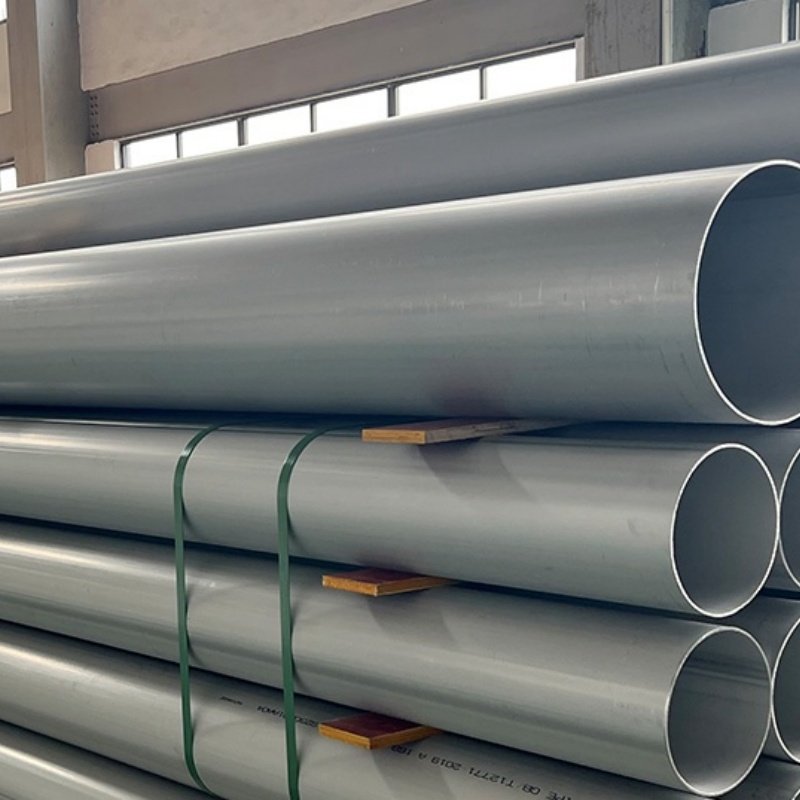
Plastic end caps, wooden crates or steel frames for bundled sizes, VCI anti-rust wrapping for
storage. Plain or beveled ends; cut-to-length available.
Applications
Furnace internals and radiant tubes, heat-treating fixtures, kiln components, heating-element
sheathing, thermal processing baskets, oxidising-atmosphere process piping, glass and cement plant
equipment.
Technical Notes
1. Aluminium and chromium, not nickel, are what separate 601 from 600.
SB-167 Table 1 gives N06600 chromium as 14.0–17.0% while N06601 is 21.0–25.0%,
and 601 additionally carries aluminium 1.0–1.7% which 600 does not. Chromium is
what stabilises the protective oxide film; aluminium accelerates the formation of a dense, adherent
scale at high temperature and markedly improves carburisation resistance. Since 600’s chromium stops at
17%, its oxide layer grows faster in a long-duration oxidising atmosphere. When the medium is oxidising
and the service temperature sits above roughly 593 °C for extended periods, moving up to 601 is
a materials decision, not something that can be solved by increasing the wall thickness of 600.
2. Carburisation resistance is won at the grain boundary, and that is also the failure mode.
In a CO/CH4-rich furnace atmosphere, the high nickel of 601 lowers carbon solubility in the
austenite matrix, so carbon is forced to precipitate at grain boundaries rather than within grains.
That is precisely what produces the carburisation resistance. The same location is the weakness: once a
continuous grain-boundary carbide network forms, the material loses toughness, and a rapid cool-down
during an unplanned shutdown can turn that loss into cracking. For furnace tube service the delivery
condition must be solution annealed, and the pipe must not have picked up excessive cold work before
delivery.
3. 601’s strength envelope is not the same as 600’s, and wall calculations must be redone.
For N06601, SB-167 gives a tensile minimum of 80 000 psi (550 MPa) and a yield minimum of
30 000 psi (205 MPa) with 30% minimum elongation in the annealed condition. When 601 is used as a
pressure-retaining component, the allowable stress has to be taken from the N06601 line in the ASME
Section II Part D tables rather than carried over from a 600 calculation. The design intent of
601 is heat resistance and oxidation resistance, not higher pressure capability, so assuming a 600
result will transfer directly is not a safe shortcut.
Frequently Asked Questions
What is Incoloy 601?
A nickel-chromium-iron-aluminium alloy, UNS N06601, covered by ASME SB-167. Compared with alloy 600
it has higher chromium at 21.0–25.0% plus aluminium at 1.0–1.7%, giving better oxidation and
carburisation resistance at high temperature.
Which ASME specification covers Incoloy 601 pipe?
ASME SB-167, identical to ASTM B167, Nickel-Chromium-Iron Alloys Seamless Pipe and Tube. SB-446 is a
rod and bar specification for a different alloy family and does not apply to this product form.
What is the annealing condition for 601?
A solution anneal followed by water quench or rapid air cooling. Bright annealed and pickled finishes
are both available; specify the finish on the order.
What is the minimum yield strength of 601?
30 000 psi (205 MPa) with 30% minimum elongation in the annealed condition, per SB-167, with a tensile
minimum of 80 000 psi (550 MPa).
What is the allowable fibre stress for hydrostatic testing?
20 000 psi (140 MPa) for hot-worked or hot-worked annealed material, and 20 000 psi (140 MPa) for
cold-worked annealed material, all sizes, per SB-167.
Do you supply 601 in cut-to-length pipe?
Yes. Please confirm required length, OD, wall thickness and end preparation.