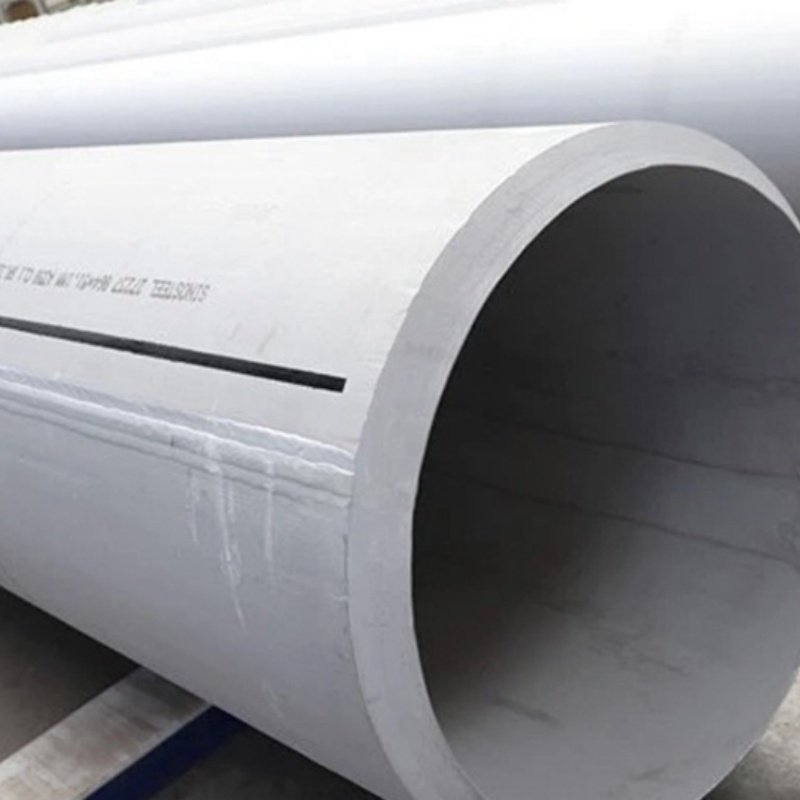

Hastelloy C-276 seamless pipe (UNS N10276) is a nickel-chromium-molybdenum-tungsten alloy produced to ASME SB-622. It is the general purpose corrosion workhorse of the nickel alloy family, with roughly 16% chromium, 16% molybdenum and 4% tungsten. Very low carbon and silicon levels give it outstanding resistance to intergranular corrosion in the weld heat-affected zone, which is what allows it to be used in as-welded fabrication.
C-276 handles both reducing acids such as hydrochloric and sulphuric acid, and oxidising media such as wet chlorine, hypochlorite and nitric acid, which is unusual for a single alloy and is why it appears in almost every chemical process plant.
Specification and Designation
| Designation | Value |
|---|---|
| UNS number | N10276 |
| ASME specification | SB-622 |
| ASTM equivalent | B622 (seamless pipe and tube) |
| Material class | Low-carbon Ni-Cr-Mo-W alloy |
Chemical Composition (ASME SB-622, Table 1)
| Element | Composition, % | Element | Composition, % |
|---|---|---|---|
| Nickel | Remainder | Carbon | 0.010 max |
| Chromium | 14.5 – 16.5 | Silicon | 0.08 max |
| Molybdenum | 15.0 – 17.0 | Cobalt | 2.5 max |
| Tungsten | 3.0 – 4.5 | Manganese | 1.0 max |
| Iron | 4.0 – 7.0 | Vanadium | 0.35 max |
| Phosphorus | 0.04 max | Sulfur | 0.03 max |
Limits quoted directly from ASME BPVC Section II Part B, SB-622 Table 1. The tight carbon (0.010 max) and silicon (0.08 max) maxima are the signature of this alloy.
C-276 versus C-22 and B-2
| Alloy | UNS | Cr, % | Mo, % | W, % | Character |
|---|---|---|---|---|---|
| C-276 | N10276 | 14.5–16.5 | 15.0–17.0 | 3.0–4.5 | Broadest, best all-round corrosion resistance, best weldability |
| C-22 | N06022 | 20.0–22.5 | 12.5–14.5 | 2.5–3.5 | Better in strongly oxidising acid such as nitric |
| B-2 | N10665 | 26.0–30.0 | 4.0–6.0 | — | Best in strong reducing acid, but prone to HAZ attack |
All three are supplied by us. The practical rule: choose C-276 as the default, C-22 for nitric-dominant oxidising service, B-2 only where reducing acid dominates and the fabrication can be solution annealed after welding.
Supply Range
| Parameter | Range |
|---|---|
| Outer diameter | 6 mm – 610 mm (1/4″ – 24″) |
| Wall thickness | 0.5 mm – 40 mm |
| Length | Random length, or cut to customer requirement |
| Condition | Solution annealed |
Testing and Inspection
- EN 10204 3.1 mill test certificate, third-party inspection available on request
- Hydrostatic or nondestructive electric test on every tube
- Full chemical analysis; actual heat values shown on the certificate
- Intergranular corrosion test to ASTM G28 (typically practice A or C depending on service) available on request
- Ferrite content check on weld consumables where required by the applicable code
- Dye penetrant inspection on all pipe; ultrasonic testing on heavy wall and forgings
Surface, Marking and Packing
Solution annealed with a pickled or bright annealed surface, capped both ends and individually sleeved. Marked with heat number, grade, standard, size and works mark. Export packing in wooden cases or steel pallets with plastic end caps.
Applications
- Pulp and paper bleaching and chlorination systems
- Hydrochloric and sulphuric acid handling, including reactors and absorbers
- Wet chlorine, chlorine dioxide and hypochlorite piping
- Flue gas desulphurisation scrubbers and absorber nozzles
- Farm-levelled pharmaceutical and fine chemical processing
- Oil and gas sour gas, amine and acid gas systems
- Pickling lines and acid regeneration
Related Products
For chromium-bearing nickel alloys with different corrosion envelopes, see our Inconel 625 seamless pipe (higher strength, better chloride pitting margin) and our Monel 400 seamless pipe (nickel-copper, for caustic and chloride SCC immunity).
Technical Enquiries
Tell us the grade, dimensions, quantity and the exact service medium and concentration, plus any third-party inspection requirement. We will confirm the ASTM or EN line item, the delivery condition and the appropriate intergranular corrosion test, and quote FOB Shanghai or Ningbo.
Frequently Asked Questions
Why is C-276 preferred over B-2 in welded fabrication?
B-2 relies on post-weld solution annealing because its higher carbon and silicon leave it susceptible to intergranular attack in the heat-affected zone. C-276’s very low carbon and silicon content remove that requirement, so C-276 can be welded and put into service without heat treatment. That usually decides the choice on fabrication cost alone.
Is C-276 resistant to chloride pitting and crevice corrosion?
Yes, but it is not the best choice where seawater is the only concern. With a PREN in the high 40s, Inconel 625 gives more margin for seawater and chloride pitting, and titanium gives more still. C-276 is chosen when acids, especially oxidising or mixed acids, are present alongside chlorides.
Can C-276 be used in wet chlorine service?
Yes. C-276 is one of the few alloys usable in wet chlorine, and it is widely applied in chlorine, chlorine dioxide and bleach handling. Specify the exact concentration and temperature and we will confirm the design limits.
What intergranular corrosion test should be specified?
For most oxidising service, ASTM G28 practice A (ferric sulphate, 120°C, 24 h) is the standard screen. For reducing acid service, practice C (Huey) is more appropriate. We will run whichever matches the service and issue the results with the certificate.
Do you supply C-276 with EN 10204 3.1 certification?
Yes, as standard. Third-party inspection by Lloyd’s, BV, DNV, SGS or TUV can be arranged with release applied before shipment.