
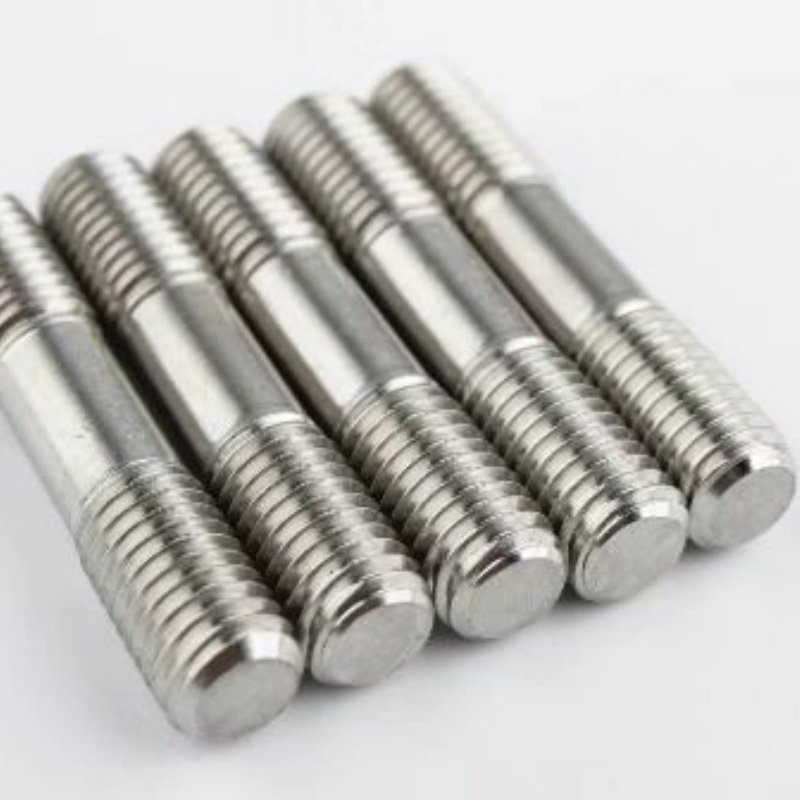
Studs are cylindrical fasteners with no head and threads on both ends, widely used in flange connections, pressure vessels, heat exchangers, and heavy equipment fastening. The nickel alloy studs supplied by us are manufactured from high-quality nickel-based alloy bars through multiple precision processes including thread rolling/chasing, solution heat treatment, and surface treatment. Featuring no head limitation, fastening capability on both ends, uniform stress distribution, and excellent corrosion resistance, they are specifically designed for flange connections and critical equipment fastening under high temperature, high pressure, and severe corrosion conditions.
Supply Range
Nominal Diameter (d): M6 – M100 (1/4 inch – 4 inches); Larger diameters negotiable
Length (L): 20mm – 6000mm (customized as per customer requirements)
Thread Specification Coarse Thread , Fine Thread, Metric Thread
Thread Accuracy: 6g (common for external threads), 4h/6h precision grades available
Stud Type: Full Thread Stud, Double-End Stud, Reduced Shank Stud
End Treatment: Chamfered End, Plain End, Tapered End
Strength Grade: Determined by material and heat treatment process, meeting ASTM F468 requirements
Surface Condition: Pickled, Passivated, Polished optional
Special Specification Notes:
Extra-Long Studs: Available up to 6000mm for special structural connections
Non-Standard Diameters: Various non-standard diameters available as per drawings
Fine Thread: Suitable for high-pressure flange connections, more precise preload control
Reduced Shank Studs: For applications with significant thermal expansion, providing elasticity
Quality Assurance
- Thread Processing Inspection
Thread Accuracy: Go/No-Go gauge inspection using thread gauges, ensuring thread conformity
Thread Surface: Visual inspection, no burrs, no damage, no folding
- 2. Heat Treatment Verification
Solution Heat Treatment Temperature Recording: Providing heat treatment curve charts
Intergranular Corrosion Testing: Verifying heat treatment effectiveness per ASTM A262 standard
- 3. Mechanical Property Testing
Tensile Testing: Sampling testing per batch, verifying mechanical properties
Hardness Testing: Batch sampling testing, ensuring consistency
- 4.Dimensional and Appearance Inspection
Diameter: Measuring various diameters using calipers, micrometers
Length: Measuring overall length using tape measures, calipers
Straightness: Measuring stud straightness, ensuring compliance
Surface Quality: Visual inspection, no cracks, pits, rust
- 5. Non-Destructive Testing
Penetrant Testing (PT): Surface inspection for critical service studs
Ultrasonic Testing (UT): Internal defect inspection for large diameter studs