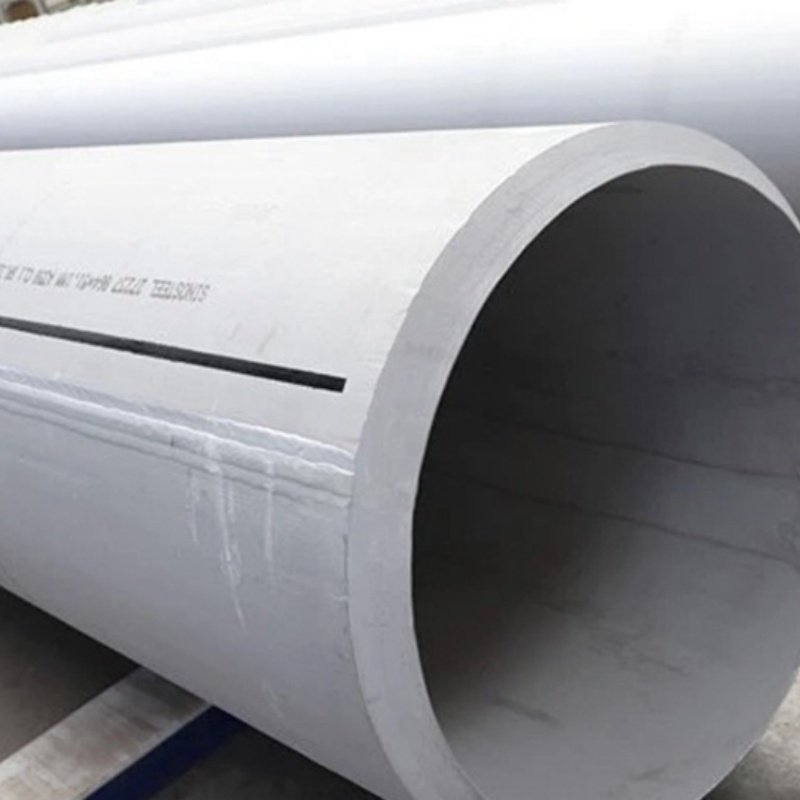


Stainless steel mechanical tubing is ordered by actual outside diameter, nominal wall and length under ASTM A269/A269M, not by NPS schedule. A269 covers seamless and welded austenitic tubing for general corrosion-resisting and low- or high-temperature service. This page covers TP304, TP304L, TP316, TP316L and TP321 with their UNS identities.
The standard’s mechanical logic is different from A312 pipe. It uses hardness, flaring or flange tests, reverse flattening for welded tube, and a hydrostatic or nondestructive electric test. It does not assign the familiar A312 tensile/yield minima to these tubing grades; values from another product specification must not be copied onto an A269 certificate.
Grade, UNS and Specification
| Grade | UNS | Standard | Order basis | Mechanical acceptance |
|---|---|---|---|---|
| TP304 / TP304L | S30400 / S30403 | ASTM A269/A269M | Actual OD × nominal wall × length | Hardness and forming/integrity tests |
| TP316 / TP316L | S31600 / S31603 | ASTM A269/A269M | Actual OD × nominal wall × length | Hardness and forming/integrity tests |
| TP321 | S32100 | ASTM A269/A269M | Actual OD × nominal wall × length | Hardness and forming/integrity tests |
Chemical Composition (ASTM A269 Table 1)
| Grade | C max | Cr | Ni | Mo | N / other requirement |
|---|---|---|---|---|---|
| TP304 (S30400) | 0.08 | 18.0–20.0 | 8.0–11.0 | No requirement | No requirement |
| TP304L (S30403) | 0.035B | 18.0–20.0 | 8.0–12.0 | No requirement | No requirement |
| TP316 (S31600) | 0.08 | 16.0–18.0 | 10.0–14.0 | 2.00–3.00 | No requirement |
| TP316L (S31603) | 0.035B | 16.0–18.0 | 10.0–15.0 | 2.00–3.00 | No requirement |
| TP321 (S32100) | 0.08 | 17.0–19.0 | 9.0–12.0 | No requirement | Ti ≥ 5(C+N), 0.70 max |
For all five rows: Mn 2.00 max, P 0.045 max, S 0.030 max and Si 1.00 max. A269 note B permits 0.040 % C max for small-diameter or thin-wall L grades where many drawing passes are required; small OD is below 0.500 in. [12.7 mm] and light wall is below 0.049 in. [1.2 mm] minimum wall.
Mechanical Acceptance (ASTM A269 Table 2)
| Grade group | Austenitizing minimum | Hardness max | Tensile / yield / elongation |
|---|---|---|---|
| TP304, TP304L, TP316, TP316L, TP321 | 1900 °F [1040 °C] | 192 HBW / 200 HV or 90 HRB | Not specified by the A269 base requirements; add a project requirement if needed |
A269 instead requires hardness and the applicable forming and integrity tests. Hardness testing is not required below 1/4 in. [6.4 mm] ID or below 0.020 in. [0.51 mm] wall; the smaller/thinner-tube route refers to A632 tension testing.
Size Range and OD × Wall
| Order item | A269 basis / requirement |
|---|---|
| Outside diameter | Actual OD specified by the purchaser; not an NPS schedule |
| Usual inside-diameter envelope | 1/4 in. [6.4 mm] and larger |
| Usual nominal wall envelope | 0.020 in. [0.51 mm] and heavier |
| Length | Cut or random length stated on the order |
| Exact OD × wall availability | TBC against the specific enquiry; no stock range is invented here |
ASME SA-1016 / ASTM A1016 supplies general tube requirements unless A269 provides otherwise. Very thin-wall tubing needs an agreed measurement method because contact measurement and ovality can affect acceptance.
Manufacturing Route and Heat Treatment
A269 permits seamless or welded manufacture, hot or cold finished. All five grades are solution heat treated at 1900 °F [1040 °C] minimum and water quenched or rapidly cooled. The usual size envelope is 1/4 in. [6.4 mm] ID and larger with nominal wall 0.020 in. [0.51 mm] and heavier. The purchase order should still use actual OD × wall, because ID scope language is not an OD stock-range claim.
Inspection, Testing and Certification
- Forming tests: flaring for seamless tube; flange and reverse-flattening tests for welded tube, using the applicable A269 and A1016 requirements.
- Integrity test: every tube is subjected to hydrostatic or nondestructive electric testing; specify the preferred method on the purchase order.
- Mechanical and dimensional checks: hardness where applicable, actual OD, nominal wall, length, ovality/straightness, surface and end condition. UT, PMI or additional NDE are supplementary when ordered.
- Documentation: heat traceability and test results should match A269 rather than borrowed A312 values. EN 10204 3.1/3.2 and third-party inspection are confirmed case by case in the quotation.
Packing & Delivery
Plastic end caps; steel frames or wooden crates for larger diameters; VCI protective wrapping where required. Beveled or plain ends are confirmed with the order. Marking should maintain the link between each length, standard, grade/UNS, size and heat number. Delivery schedule, quantity, MOQ and price are confirmed only against a specific enquiry.
Applications
Instrumentation and analyzer lines, hydraulic and pneumatic circuits, machinery and skid tubing, chemical-injection lines, process utilities, heat-transfer auxiliaries, and general mechanical fabrication. A269 is not automatically a sanitary-tube, boiler-tube or A312 process-pipe substitute; use the standard that matches the service and design code.
Technical Notes
1. Tubing chemistry is not interchangeable with A312 chemistry. A269 TP316L has Ni 10.0–15.0 %, whereas A312 TP316L has 10.0–14.0 %. A269 TP304L has Ni 8.0–12.0 %, versus 8.0–13.0 % in A312. The same UNS and similar grade name therefore do not make the two certificates identical; review against the specification named on the order.
2. Hardness is an acceptance property, not a missing-data shortcut. Table 2 sets 192 HBW / 200 HV or 90 HRB max for all five grades. A269 also defines when small or thin tubes are exempt and refers that route to A632 tension testing. If a pressure design requires guaranteed tensile or yield values, those values and their test method must be added explicitly rather than assumed from pipe tables.
3. Seamless and welded tubes follow different forming checks. Seamless tube uses the flaring test; welded tube uses flange and reverse-flattening tests. Every tube undergoes hydrostatic or nondestructive electric testing, with the method at the manufacturer’s option unless the order selects one. This is why an instrumentation or mechanical-tube enquiry should state route, OD, wall, length, surface condition and preferred integrity test together.
For NPS process pipe see 304/304L or 316/316L seamless pipe; send tubing sizes through the enquiry form.
Frequently Asked Questions
How should A269 mechanical tubing be ordered?
Use actual outside diameter, nominal wall thickness, length, grade/UNS, seamless or welded route, surface condition and the required integrity test. Do not substitute an NPS schedule description.
Does ASTM A269 specify tensile and yield strength for these grades?
The base A269 requirements use hardness and forming/integrity tests rather than the A312 tensile table. If guaranteed tensile, yield or elongation values are needed, state the project requirement explicitly.
What hardness applies to TP304L and TP316L tubing?
A269 Table 2 gives 192 HBW / 200 HV or 90 HRB maximum, with a 1900 F [1040 C] minimum austenitizing temperature for both.
Is every A269 tube pressure tested?
Every tube receives either a hydrostatic or nondestructive electric test. The manufacturer selects unless the purchase order specifies the method.
What size envelope does A269 describe?
Usually furnished sizes are 1/4 in. [6.4 mm] ID and larger with nominal wall 0.020 in. [0.51 mm] and heavier. Actual availability by OD and wall is confirmed against the enquiry.