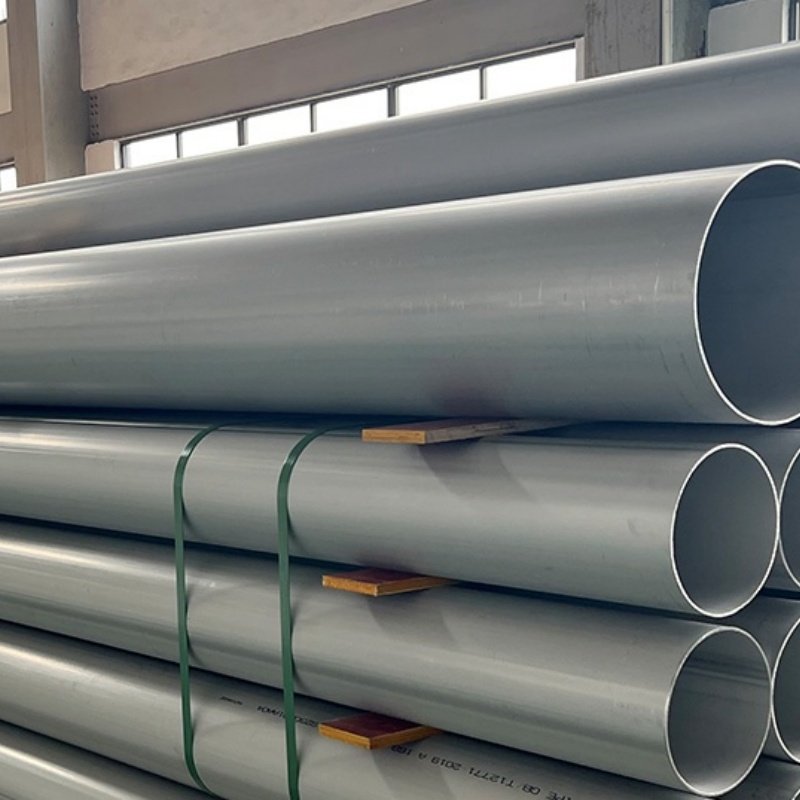

316/316L stainless steel seamless pipe uses the molybdenum-bearing branch of ASME SA-312: TP316 is UNS S31600 and TP316L is UNS S31603, with ASTM A312/A312M as the corresponding designation. Both grades require 2.00–3.00 % molybdenum. The L variant is a separate chemistry-and-strength row, not merely a welding suffix.
The useful purchasing distinction is to specify what must be demonstrated: heat chemistry, room-temperature tensile properties, dimensional conformity, and either hydrostatic or nondestructive examination. Molybdenum content alone does not define a seawater rating, a chloride limit or a safe design pressure; those remain application and code decisions.
Grade, UNS and Specification
| Grade | UNS | ASME / ASTM designation | Molybdenum | Minimum tensile / yield |
|---|---|---|---|---|
| TP316 | S31600 | SA-312 / A312 TP316 | 2.00–3.00 % | 75 / 30 ksi (515 / 205 MPa) |
| TP316L | S31603 | SA-312 / A312 TP316L | 2.00–3.00 % | 70 / 25 ksi (485 / 170 MPa) |
Chemical Composition (ASME SA-312 Table 1)
| Element, weight % | TP316 (S31600) | TP316L (S31603) |
|---|---|---|
| Carbon, max | 0.08 | 0.035 |
| Manganese, max | 2.00 | 2.00 |
| Phosphorus, max | 0.045 | 0.045 |
| Sulfur, max | 0.030 | 0.030 |
| Silicon, max | 1.00 | 1.00 |
| Chromium | 16.0–18.0 | 16.0–18.0 |
| Nickel | 10.0–14.0 | 10.0–14.0 |
| Molybdenum | 2.00–3.00 | 2.00–3.00 |
| Titanium / nitrogen | No requirement | No requirement |
Tensile Requirements (ASME SA-312 Table 4)
| Grade | Tensile min, ksi (MPa) | 0.2 % yield min, ksi (MPa) | Elongation longitudinal / transverse, min % |
|---|---|---|---|
| TP316 | 75 (515) | 30 (205) | 35 / 25 |
| TP316L | 70 (485) | 25 (170) | 35 / 25 |
Size Range and OD × Wall
| NPS | OD, in. (mm) | Sch 5S wall, in. (mm) | Sch 10S wall, in. (mm) | Sch 40S wall, in. (mm) | Sch 80S wall, in. (mm) |
|---|---|---|---|---|---|
| 1/2 | 0.84 (21.34) | 0.065 (1.65) | 0.083 (2.11) | 0.109 (2.77) | 0.147 (3.73) |
| 3/4 | 1.05 (26.67) | 0.065 (1.65) | 0.083 (2.11) | 0.113 (2.87) | 0.154 (3.91) |
| 1 | 1.315 (33.4) | 0.065 (1.65) | 0.109 (2.77) | 0.133 (3.38) | 0.179 (4.55) |
| 1-1/2 | 1.9 (48.26) | 0.065 (1.65) | 0.109 (2.77) | 0.145 (3.68) | 0.2 (5.08) |
| 2 | 2.375 (60.33) | 0.065 (1.65) | 0.109 (2.77) | 0.154 (3.91) | 0.218 (5.54) |
| 3 | 3.5 (88.9) | 0.083 (2.11) | 0.12 (3.05) | 0.216 (5.49) | 0.3 (7.62) |
| 4 | 4.5 (114.3) | 0.083 (2.11) | 0.12 (3.05) | 0.237 (6.02) | 0.337 (8.56) |
| 6 | 6.625 (168.28) | 0.109 (2.77) | 0.134 (3.4) | 0.28 (7.11) | 0.432 (10.97) |
| 8 | 8.625 (219.08) | 0.109 (2.77) | 0.148 (3.76) | 0.322 (8.18) | 0.5 (12.7) |
| 10 | 10.75 (273.05) | 0.134 (3.4) | 0.165 (4.19) | 0.365 (9.27) | 0.5 (12.7) |
| 12 | 12.75 (323.85) | 0.156 (3.96) | 0.18 (4.57) | 0.375 (9.52) | 0.5 (12.7) |
Selected rows from ANSI B36.19 Table 1 as reproduced in the ASME library. NPS is a designation; the OD shown is the controlling outside diameter. Other schedules and sizes are subject to the specification and enquiry. Wall tolerance is governed separately by SA-312 Table 3.
Manufacturing Route and Heat Treatment
The seamless pipe route is followed by hot or cold finishing and solution annealing. TP316 and TP316L are covered by SA-312 Table 2’s general minimum of 1900 °F [1040 °C], with water quench or other rapid cooling. The cooling condition matters because slow passage through a sensitizing range can undo the intended austenitic condition. Bevel, plain-end and surface requirements are purchase-order details, not properties implied by the grade name.
Inspection, Testing and Certification
- Heat and product verification: review heat number, UNS/grade, chemical analysis and the specified mechanical result against the named standard, not against a generic grade datasheet.
- Pipe tests: SA-312 Sections 11 and 13 cover tension/flattening and hydrostatic or nondestructive electric examination as applicable. Additional UT, eddy current, impact, PMI or hardness requirements must be defined on the order.
- Dimensions and surface: confirm actual OD, wall, length, end preparation and surface condition. Hydrostatic P = 2St/D is not a design-pressure calculation.
- Documentation: request the MTC route at enquiry stage. EN 10204 3.1 or 3.2, purchaser witnessing and third-party inspection are order-specific options to be confirmed in the quotation, not an automatic certificate bundle.
Packing & Delivery
Plastic end caps; steel frames or wooden crates for larger diameters; VCI protective wrapping where required. Beveled or plain ends are confirmed with the order. Marking should maintain the link between each length, standard, grade/UNS, size and heat number. Delivery schedule, quantity, MOQ and price are confirmed only against a specific enquiry.
Applications
Chemical dosing and process piping, offshore and coastal utility systems after project corrosion review, pharmaceutical and biotechnology utilities, pulp and paper equipment, food-processing auxiliaries, desalination auxiliary lines, and fabricated process skids. Final selection must consider crevices, deposits and cleaning chemistry rather than grade reputation alone.
Technical Notes
1. Molybdenum is the defining addition, not a blanket seawater guarantee. The 2.00–3.00 % Mo range distinguishes 316 from 304 and supports selection for pitting- and crevice-sensitive service. Actual performance still depends on chloride level, temperature, deposits, crevices, oxygen and cleaning practice. A responsible enquiry therefore states the medium and design condition instead of asking only for ‘marine-grade pipe’.
2. TP316L has a strength trade as well as a welding benefit. SA-312 sets TP316L carbon at 0.035 % max, against 0.08 % for TP316, while lowering the tensile/yield minima to 70/25 ksi from 75/30 ksi. Nickel remains 10.0–14.0 % for both under A312; do not import the different A269 tubing limits into an A312 pipe certificate.
3. Inspection choices should follow the integrity question. Table 6 lists ER316 and ER316L filler respectively. Hydrostatic testing addresses leak resistance under pressure; eddy-current or ultrasonic techniques address different flaw populations and require suitable calibration and coverage. PMI is an identity check, not a substitute for tensile or corrosion testing. EN 10204 3.2, impact testing, PMI or additional NDE should be called out explicitly when required.
Compare with 304/304L pipe, or review the pipe and tube range.
Frequently Asked Questions
What UNS numbers identify 316 and 316L pipe?
TP316 is UNS S31600 and TP316L is UNS S31603 under ASME SA-312 / ASTM A312.
Do 316 and 316L have the same molybdenum requirement?
Yes. SA-312 Table 1 requires 2.00-3.00 % Mo for both, with 16.0-18.0 % Cr and 10.0-14.0 % Ni.
Why is 316L weaker on the certificate?
The specification assigns TP316L lower minima: 70 ksi tensile and 25 ksi yield, versus 75 ksi and 30 ksi for TP316. This is a specified minimum difference, not a prediction for every heat.
Is impact testing automatic for SA-312 316L?
No. Impact testing is a project/supplementary requirement where specified, not a routine property established by the base A312 grade table.
Which fillers correspond to the two grades?
SA-312 Table 6 lists ER316 for TP316 and ER316L for TP316L, subject to the project’s welding-procedure requirements.